
Haven Hearts Bible Study - Week 6 - When Jesus Stops for You!
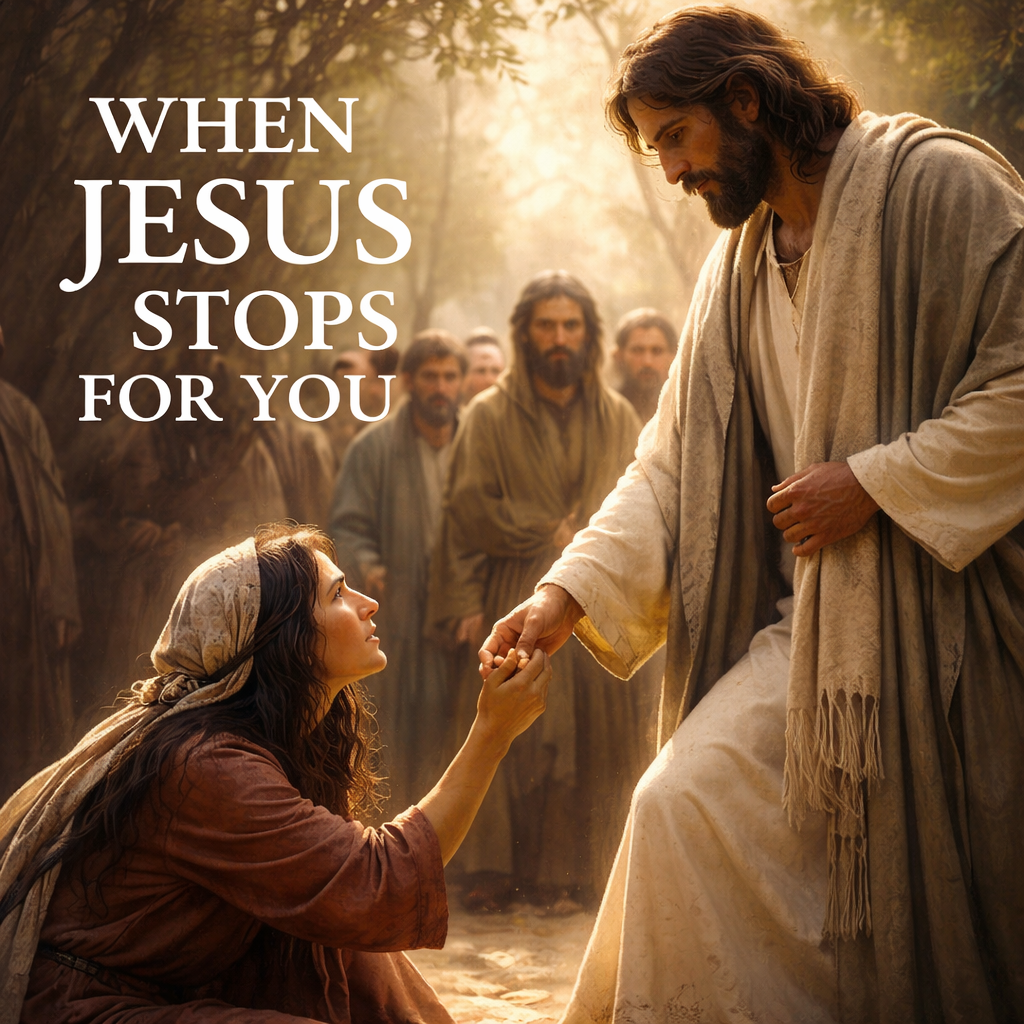
When Jesus Stops for You!
Haven Hearts Bible Study - Week 6 -
When Jesus Stops For You!
“And a woman was there who had been subject to bleeding for twelve years. She had suffered a great deal under the care of many doctors and had spent all she had, yet instead of getting better she grew worse. When she heard about Jesus, she came up behind him in the crowd and touched his cloak, because she thought, `If I just touch his clothes, I will be healed.’ Immediately her bleeding stopped and she felt in her body that she was freed from her suffering.
At once Jesus realized that power had gone out from him. He turned around in the crowd and asked, `Who touched my clothes?’ `You see the people crowding against you,’ his disciples answered, `and yet you can ask, ‘Who touched me?’ But Jesus kept looking around to see who had done it. Then the woman, knowing what had happened to her, came and fell at his feet and, trembling with fear, told him the whole truth. He said to her, `Daughter, your faith has healed you. Go in peace and be freed from your suffering.’”
Mark 5:25–34 (NIV)
Study Theme
There are seasons when what once wounded us returns disguised as love, safety, or familiarity. Because of past wounds and learned survival patterns, we may confuse what feels familiar with what is truly life-giving. Scripture reminds us that not everything familiar reflects the heart of God, and not everything called “love” brings freedom or wholeness. This study explores how personal wounds and generational brokenness can distort our understanding of love; and how Jesus, with both truth and compassion, gently exposes what is false and restores what has been wounded.
Introduction: Faith, Fear, and the Moment Power Is Drawn
There are moments in Scripture when the miracle is not only what is healed, but what interrupts Jesus Himself. Mark 5:25–34 records one of the most emotionally charged, public, and psychologically intense encounters in the Gospels. A woman reaches. Power moves. Fear erupts. And Jesus stops everything.
This chapter is centered on that interruption.
For twelve years, this woman lived inside limitation. Mark tells us she “had been subject to bleeding for twelve years” (Mark 5:25, NIV). Twelve years is long enough for pain to reshape identity. Long enough for disappointment to train expectations. Long enough for fear to become familiar.
Her condition did not only affect her body. According to Jewish law, she was ceremonially unclean. That meant separation from worship, strained relationships, and constant social isolation. Her presence carried consequence. Over time, fear taught her how to survive.
Stay quiet.
Stay back.
Don’t touch.
Don’t disrupt.
Fear became protection.
Loneliness became routine.
Invisibility became safety.
And yet, Scripture tells us something extraordinary.
She moves.
“When she heard about Jesus, she came up behind Him in the crowd and touched His cloak” (Mark 5:27, NIV). That single sentence compresses twelve years of isolation, fear, and restraint into one bold act of COURAGEOUS FAITH. Entering a crowd was dangerous. Touching anyone risked exposure. Touching a rabbi could have resulted in public rebuke or punishment.
But she is driven by something stronger than fear.
She says to herself, “If I just touch His clothes, I will be healed” (Mark 5:28, NIV).
This is not desperation untethered from belief.
This is FAITH.
FAITH formed in isolation.
FAITH exercised under fear.
FAITH embodied through action.
Hebrews 11:1 defines faith as “confidence in what we hope for and assurance about what we do not see.” This woman lives that definition. She moves before proof. She reaches without permission. Her body participates in belief.
She has nothing to lose.
And Scripture is clear: her FAITH works.
“Immediately her bleeding stopped and she felt in her body that she was freed from her suffering” (Mark 5:29, NIV). Healing begins instantly. Power flows. Something irreversible has happened.
But healing does not yet feel safe.
When Jesus Feels Power Leave Him
“At once Jesus realized that power had gone out from Him” (Mark 5:30, NIV).
This is the turning point.
Jesus does not guess. He does not wonder. He knows. This was not accidental contact in a crowded space. This was intentional faith that drew power. Scripture repeatedly shows that power flowing from Jesus is purposeful. Luke 6:19 tells us, “Power was coming from Him and healing them all.”
Power leaving Jesus is not loss.
It is fulfillment.
But for the woman, this realization would have been terrifying.
Trauma survivors often believe that receiving care costs others too much. Many live with an internal narrative that says, If I take what I need, someone else will suffer. When Jesus feels power leave Him, fear would have interpreted that sensation as danger.
I took something.
I went too far.
I wasn’t supposed to receive this.
Fear distorts generosity. Trauma teaches that love is limited and conditional. Jesus interrupts that lie by stopping and naming the moment.
“Who Touched Me?” Fear at the Edge of Healing
Jesus turns and raises His voice.
“Who touched Me?” (Mark 5:30, NIV)
This is not a quiet question.
This is a public announcement.
The crowd hears it.
The disciples react.
Time slows.
The disciples try to minimize the moment. “You see the people crowding against you,” they say (Mark 5:31, NIV). In other words, Why make this a big deal?
But Jesus refuses to minimize what matters.
Luke tells us Jesus “kept looking around to see who had done it” (Luke 8:44, NIV). He waits. He holds the tension. This is not cruelty. This is love that understands something essential: fear must be exposed to be healed.
Psychologically, this is the most dangerous moment in the entire story.
Healing has happened in her body, but fear now threatens to sabotage it. Trauma does not release simply because symptoms stop. Fear argues fast:
You crossed a line.
You took something that wasn’t yours.
You will be exposed.
You will be punished.
Fear could have driven her away.
This matters because fear can keep a person from receiving total healing. Healing is unfamiliar. Pain is known. Isaiah 53:4 tells us, “Surely He took up our pain and bore our suffering.” Jesus is not surprised by the cost, but she does not yet know that love is about to meet her fear.
Jesus holds the moment open so fear cannot send her running…
Think about what the woman with the issue of blood could be sensing and feeling compounded by the fact that her desperation has left her with nothing but fear.
Trembling Truth and the Body’s Response
Mark tells us the woman comes forward “trembling with fear” (Mark 5:33, NIV). This trembling is not doubt. It is the nervous system discharging years of stored terror. Trauma lives in the body. Fear that once protected her is now being asked to let go, and the battle begins…
She falls at His feet.
She tells Him “the whole truth.”
Not a polished testimony.
Not a sanitized version.
The whole story.
Psalm 32:3–5 reminds us that silence keeps the body sick, but truth brings release. Psychologically, this moment is narrative integration; her story becoming whole instead of fragmented.
Fear is now fully exposed.
Remember, Jesus’ voice rang out, “Who touched me?” Due to trauma and the length of her suffering, her body probably betrayed her before her mind could answer due to twelve years of suffering in silence.
The trembling began in her hands and spread, a violent shudder she could not stop. Twelve years of hiding surged to the surface, every lesson learned the hard way: Do not be seen. Do not be known. Do not reach. Her heart slammed against her ribs, not with hope now, but with terror. The crowd that had pressed around her moments before suddenly felt like a net tightening.
Her breath caught, shallow and panicked. Muscles locked as though flight might tear her apart and stillness might condemn her. She could neither run nor speak. She stood suspended between impulses; every instinct screaming at once. To flee meant exposure. To remain meant judgment. To speak meant punishment.
Her mind fractured under the weight of it. Logic abandoned her. Words dissolved. All that remained was sensation: the roar of blood in her ears, the burning certainty that she had crossed a line never meant for her to cross. She had touched holiness with unclean hands. She had dared to hope.
And now she was visible.
The healing still hummed through her body, undeniable and real, but fear eclipsed it; fear that this miracle would become her sentence. Twelve years of isolation pressed down on her chest, and she felt suddenly small again, as though her body were trying to disappear before the crowd could turn.
“Daughter” — Identity Restored Before Explanation
Jesus answers her with one word.
“Daughter.”
This is attachment language. Family language. Covenant language. It is the only time in the Gospels Jesus uses this word this way.
Fear expects rejection.
Love offers belonging.
“Daughter” means she did not steal power; she received healing.
“Daughter” means she is not in trouble; she belongs.
“Daughter” means she is safe.
Galatians 4:7 declares, “You are no longer a slave, but God’s child.” In one word, Jesus restores identity before behavior, worth before explanation.
Trauma fractures identity first.
Jesus heals it first.
Faith Named Out Loud
Then Jesus speaks the truth everyone needs to hear.
“Your faith has healed you” (Mark 5:34, NIV).
Not His power.
Not her audacity.
Her FAITH.
This public affirmation protects her healing from shame and fear. Fear cannot argue when truth is spoken aloud. Romans 8:15 reminds us that we did not receive a spirit of fear, but the Spirit of adoption.
Jesus raises His voice not to glorify Himself, but to make her healing undeniable; to her, to the crowd, and to every system that taught her she should stay invisible.
“Go in peace and be freed from your suffering” (Mark 5:34, NIV).
Peace here is not calm.
Peace is wholeness.
Nothing missing.
Nothing broken.
Healing That Is Seen and Secured
What Jesus does here is not only miraculous; it is intentional. He does not allow her healing to remain hidden, private, or unnamed. Trauma thrives in secrecy, but restoration requires witness. By calling her “Daughter” and affirming her faith aloud, Jesus ensures that what was restored internally is also secured externally. Her body is healed, her identity is reclaimed, and her place in the community is reestablished.
This moment reveals the heart of God toward those who have learned to survive quietly. Jesus does not rush past trembling faith or dismiss fearful obedience. He stops. He sees. He names. And He speaks peace where fear once ruled. For those who have lived on the margins: marked by shame, exclusion, or long seasons of silence, this passage reminds us that Jesus does not merely remove suffering; He restores belonging. Healing is not complete until the wounded know they are safe, seen, and claimed.
The same Jesus who refused to let her remain invisible still speaks this way today. He restores identity before performance, belonging before explanation, and peace before understanding. As we turn to the Scriptures that anchor this truth, we listen not just for information, but for the voice that still calls His children by name.
Anchor Scripture Cross-References (NIV)
Mark 5:25–34 — The core passage: healing, exposure, and identity restored through Jesus’ voice
Luke 8:43–48 — A parallel account emphasizing fear, trembling, and Jesus’ intentional seeing
Isaiah 53:4 — The cost of healing: suffering carried, not dismissed
Hebrews 11:1 — Faith defined not as certainty, but as trust before sight
Psalm 32:3–5 — The healing that follows truth spoken and shame released
Galatians 4:7 — Identity restored: no longer slave, but child
Romans 8:1, 15 –- Freedom from condemnation and fear; the Spirit of adoption
Together, these Scriptures reveal a consistent pattern: God heals not only bodies, but identities; calling His children out of fear, secrecy, and silence into peace and belonging.
Reflection Questions for the Week
1. Where has fear kept you from fully receiving God’s healing?
2. What parts of your story have expected judgment instead of restoration?
3. How does Jesus calling this woman “Daughter” challenge or reshape your understanding of your own worth?
4. In what ways has healing felt unfamiliar, uncomfortable, or even threatening to you?
5. What stirs in your heart when you hear Jesus say, “Your faith has healed you”?
Optional Application Question
6. This week, how can you intentionally notice or respond to God’s voice calling you by name, reminding yourself of your belonging, worth, and freedom, especially in moments of fear or uncertainty?
Closing Prayer
Jesus, You see what others overlook. You stop for trembling faith. You speak belonging before explanation and peace before understanding. For every place where fear has taught us to hide, where wounds have shaped how we understand love, we receive Your voice again, calling us not by our condition, but by our identity. Restore what has been fractured. Quiet what has been afraid. Let Your peace settle into our bodies, our stories, and our faith. Teach us to live not as those reaching in secret, but as children who belong. Amen.
Weekly Benediction
May you go in the peace Jesus speaks; the peace that makes you whole.
May fear loosen its grip as truth is named aloud.
May you remember that you are not hidden, not condemned, not unworthy.
You are seen. You are healed. You are His.
Go in peace, and be free.
Until next time…
Keep being Beautiful You!